
Legacy & Historical Importance
- Home
- Legacy
Enduring Impact
Contribution to Tribal Freedom Movement
Gundadhur emerged as a powerful tribal leader during the historic Bhumkal Rebellion of 1910 in Bastar. He united various tribal communities against British colonial rule, oppressive forest laws, heavy taxation, and exploitation. His leadership transformed scattered resistance into an organized movement rooted in unity, courage, and indigenous self-governance.
He mobilized village councils, inspired youth warriors, and strengthened traditional networks to resist colonial authority. Though the rebellion was eventually suppressed, his efforts ignited political consciousness among tribal communities. Gundadhur’s legacy became a symbol of resistance, dignity, and the enduring struggle for tribal rights and self-rule in India.
Tribal Unity
United scattered villages under collective purpose, strengthening resistance through shared identity and determination.
Cultural Defense
Protected Santhal traditions, language, and customs from erosion under colonial administrative pressure.
Land Protection
Defended ancestral lands against exploitation, safeguarding livelihood, heritage, and community survival.
Honored Legacy
Cultural & Regional Recognition
Gundadhur is deeply honored across Bastar and the wider region of Chhattisgarh as a symbol of tribal pride and resistance. His leadership during the Bhumkal Rebellion of 1910 is remembered not merely as a historical uprising but as a cultural awakening of indigenous identity. In local folklore, songs, and oral traditions, he is portrayed as a courageous protector of land, forests, and community rights. Elders narrate his bravery to younger generations, keeping his memory alive in village gatherings and festivals. His name has become synonymous with self-respect, unity, and the enduring spirit of Bastar’s tribal heritage.
In regional commemorations, Gundadhur is publicly celebrated through statues, memorials, and annual observances dedicated to the Bhumkal movement. Schools, institutions, and public spaces in Chhattisgarh bear his name, reflecting the institutional recognition of his contribution to India’s freedom struggle. Government and cultural organizations conduct programs highlighting his role in defending tribal autonomy against colonial oppression. These events not only honor his sacrifice but also reinforce awareness of tribal history within mainstream narratives. Through such recognition, Gundadhur’s legacy continues to inspire civic pride and regional identity among the people of Bastar.
Culturally, Gundadhur represents the values embedded within traditional Bastar society—collective decision-making, respect for nature, and social justice through community councils. His image often appears in local art forms, murals, and tribal crafts, symbolizing resistance rooted in indigenous wisdom. Performances during festivals reenact scenes from the Bhumkal Rebellion, connecting history with living tradition. For many tribal communities, he is more than a historical figure; he is a cultural guardian whose life affirms their distinct identity. This artistic and ritual remembrance ensures that his contribution remains woven into the everyday cultural fabric of the region.
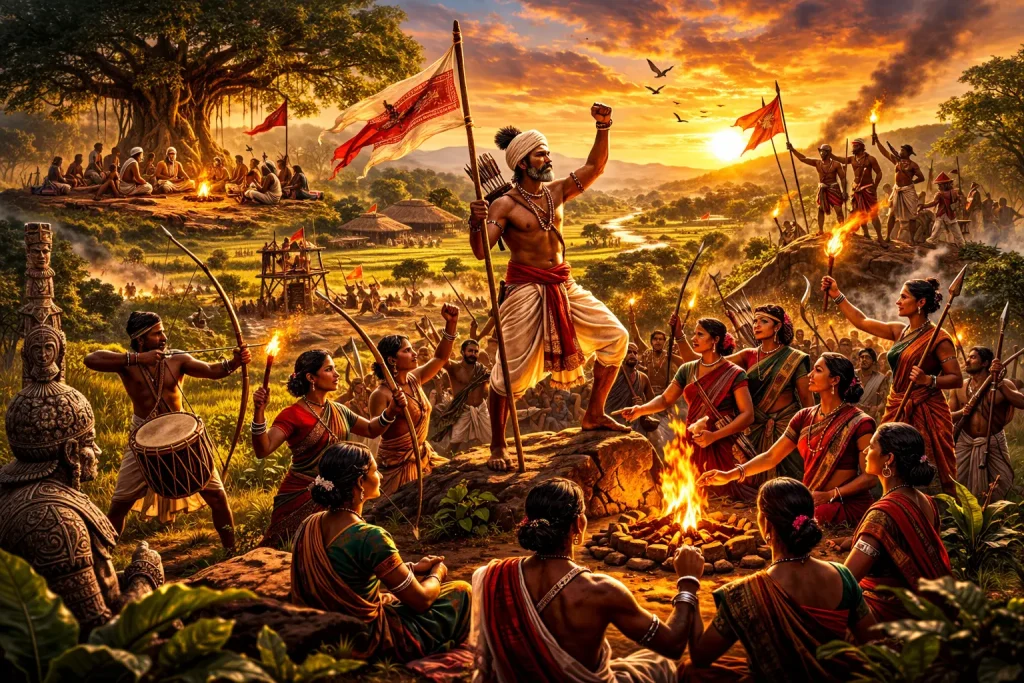
Honored Legacy
Cultural & Regional Recognition
Gundadhur is widely honored in Bastar and across Chhattisgarh as a symbol of tribal courage and resistance. His leadership during the Bhumkal Rebellion of 1910 is remembered through local folklore, songs, and oral traditions that celebrate his bravery and commitment to protecting tribal land and identity. Village elders recount his story during gatherings and cultural festivals, ensuring that younger generations understand his role in defending community rights.
Gundadhur s courage motivated future tribal leaders to organize communities with unity, discipline, and cultural conviction. His example demonstrated that resistance rooted in identity and collective strength could challenge external domination and preserve indigenous dignity.
Gundadhur’s courage motivated future tribal leaders to organize communities with unity, discipline, and cultural conviction. His example demonstrated that resistance rooted in identity and collective strength could challenge external domination and preserve indigenous dignity.
Gundadhur’s courage motivated future tribal leaders to organize communities with unity, discipline, and cultural conviction. His example demonstrated that resistance rooted in identity and collective strength could challenge external domination and preserve indigenous dignity.